Below is a Scribd document with tips for making an opening title sequence which was written by OCR examiner, Pete Fraser.
Pre-Production is a vital stage to creating the opening title sequence, it is just as important to research, plan and record evidence as it is shooting the actual sequence.
A useful thing to do is look at previous' students work to see what they did and the sort of grades they got.
An opening title sequence to a film is used to establish the style of the film and sometimes is used to introduce: character, location, narrative, genre and themes.
It is imperative that the opening title sequence to a film creates a good first impression for its audience. A good opening title sequence sets the tone of the film for the audience but does not give too much away.
Some films create "full on" opening title sequences but others do not, either due to restraints on money or preference of the directors. Some films prefer to take the audience right into the action at the very start of the film.
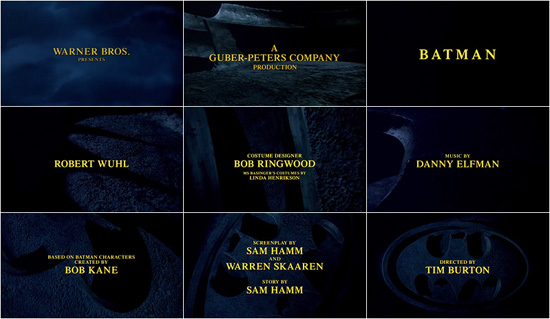
OTS to Batman (1989)
OTS to Se7en (1995), Fight Club (1999), Panic Room (2000), The Girl with the Dragon Tattoo (2011)
The image and YouTube embedded clip above shows how OTS' differ from film to film and also how they have changed over time, from the 1980s up until 2011.
Steve Curran, a motion graphics author said "film titles, to a large degree, are the afterthought of the movie production; their typical budget was described by one practitioner as 'whatever is left after the caterer has been paid at the wrap party.'"
So, in the past, opening title sequences to a film were not largely valued as they did not consist of much; only a few names and text against a simple background.
However, now OTS' have become more valued by film makers because it is vital to create a good first impression of a film, so that the audience will become more engaged with it and become interested from the beginning.
Also, now OTS' are more than just text since the 1920s, due to advances in technology some titles contain special effects and motion graphics. This has made them more interesting to watch and allows producers to capture an audience more effectively.
From OCR: "Create the titles and opening of a new fiction film, to last a maximum of two minutes. All video and audio material must be original, produced by the candidate(s), with the exception of music or audio effects from a copyright-free source. The main tasks may be done individually or as a group. Maximum of four members to a group."
Advice for creating OTS' from Examiners
An examiner stated from marking previous films, “Some submissions were very short, the target should be as close to two minutes as possible; there is no penalty for being either over length or significantly under, but candidates cannot expect to do themselves justice in a piece as short as one minute unless it contains immense complexity.”
Last year the moderator commented, "I would recommend that candidates consider the use of royalty free music at an earlier point to avoid changes as they near completion."
Stuart Hall was a cultural theorist, who looked at the role of audience positioning in the interpretation of mass media. He thought of 3 ways in which people read a media text.
(1) Dominant Reading: the reader perceives the media text in the intended way set by the producers. (2) Negotiated Reading: the reader partially perceives the media text in the intended way set by the producers, however, changes it to suit their own personality.
(3) Oppositional Reading: the reader has read a text in a way that was not intended by the producers, due to their social position.
Hall believed that media power creates dominant ideology and that mass media defines important issues through audience positioning.
Polysemy: how a text can have multiple meanings and how different individuals interpret and decode the same text differently based on their culture.
When I come to creating my OTS, I will consider audiences using Hall's reception theory. As I am creating a thriller OTS, I think that I want the audience to think for themselves and figure out the enigma so I will consider negotiated reading as this will add suspense.